

Piggly Wiggly History
Piggly Wiggly, which is run by Piggly Wiggly, LLC—a part of C&S Wholesale Grocers—is a grocery store chain hanging out in the Southern and Midwestern parts of the U.S.
Its inaugural store opened in 1916 in Memphis, Tennessee, marking the beginning of the first true self-service grocery store.
The company pioneered several common supermarket features like checkout stands, individual item price marking, and shopping carts.
The company’s headquarters is presently located in Keene, New Hampshire. With 499 independently owned stores, it serves customers in 18 states, primarily in smaller cities and towns.

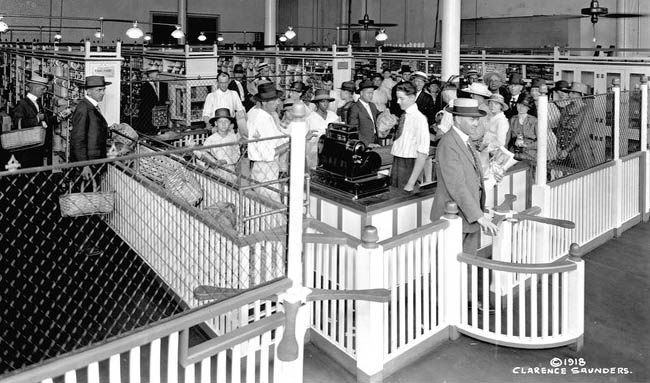
Founded on September 6, 1916, by Clarence Saunders in Memphis, Tennessee, Piggly Wiggly revolutionized the grocery industry as the first self-service store.
It allowed customers to gather their goods, cutting costs and prices.
The concept, known as a “groceteria,” secured a patent in 1917.
The company revolutionized the shopping experience in 1937 by introducing the iconic shopping cart, setting the stage for an extraordinary evolution in retail!
They were trailblazers, pioneering point of sale lanes that transformed the way we make payments, paving the path for a seamless experience that we enjoy today!
The Peak
At its highest point in 1932, the company ran 2,660 stores and had yearly sales exceeding $180 million.
Despite its success, a stock squeeze in 1922 led to financial challenges.
The company was divided and sold to regional chains like Kroger and Safeway.
Canadian stores were sold to Canada Safeway, later merging with Sobeys in 2013.
Saunders, after losing control, continued experimenting with automated shopping until his death in 1953.
The company’s changed corporate structure thrived into the 1960s under a franchise agreement with the Piggly Wiggly Corporation of Jacksonville, Florida.

The Company’s Progression
In 1982, Malone & Hyde acquired the company, later being acquired by Fleming Companies in 1988.
Fleming filed for bankruptcy in 2003, leading to C&S Wholesale Grocers acquiring most of the business, including Piggly Wiggly.
C&S further expanded by acquiring regional warehouses Piggly Wiggly Carolina in 2013 and Piggly Wiggly Midwest in 2021.

With more than 600 independently owned and operated stores spanning 18 states, the corporate headquarters is situated in Keene, New Hampshire.
In Alabama, some stores formed the Piggly Wiggly Alabama Distributing Company, a retailers’ cooperative managing distribution while using the Piggly Wiggly name.
The Piggly Wiggly Name
The company’s website notes that Saunders was “reluctant” to disclose the origin of the company’s name.
One account suggests that, while on a train, he observed small pigs trying to pass under a fence, inspiring the name.
When questioned about the unconventional choice, Saunders responded, “So people will ask that very question.”
Piggly Wiggly Trivia
- First Self-Service Store: Piggly Wiggly, founded in 1916, was the pioneer of the first true self-service grocery store, revolutionizing the traditional grocery shopping model.
- Innovative Founder: Clarence Saunders changed shopping by letting customers walk around the store and collect their items instead of handing lists to clerks.
- Groceteria Concept: The self-service format introduced by PW, known as a “groceteria,” marked a shift in how customers experienced grocery shopping, resembling the concept of cafeterias.
- Patented Self-Service Format: In 1917, PW Corporation secured a patent for the self-service format, further establishing its innovative approach to grocery retail.
- Shopping Cart Pioneers: The company made history in 1937 by becoming the first company to provide shopping carts for customers, enhancing the convenience of the shopping experience.
- Point of Sale Lanes: Another first for The company was the introduction of point of sale lanes for payment, streamlining the checkout process and setting a trend for the industry.
- Stock Market Drama: In 1922, a stock squeeze involving the company caused significant financial problems for Clarence Saunders, showing the company’s influence beyond retail.
- Expansion and Success: At its peak in 1932, The company operated an impressive 2,660 stores and achieved annual sales exceeding $180 million.
- Corporate Changes: Following financial difficulties, the company underwent strategic division and sales to regional grocery chains, including Kroger, Safeway, National Tea, and Colonial.
- Legacy and Franchising: Despite challenges, The company’s innovative corporate structure thrived into the 1960s, with hundreds of stores operating under franchise agreements with the Piggly Wiggly Corporation of Jacksonville, Florida.
Please leave your comments in the “Leave a Reply” section at the bottom of this page